Subterranean termite treatment in Baton Rouge resolves the distinct risk created when subterranean pests build mud tubes over concrete foundations to reach interior wood framing. In East Baton Rouge Parish, high…
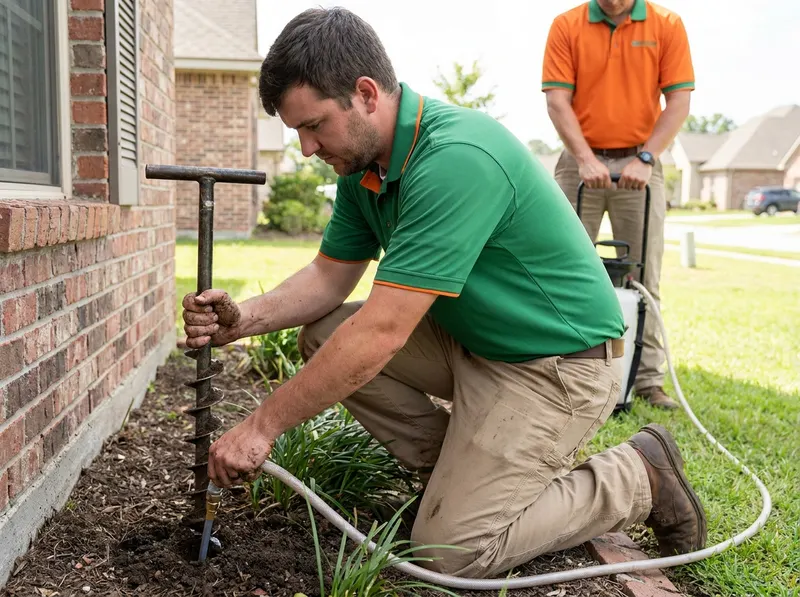
Subterranean termite treatment in Baton Rouge resolves the distinct risk created when subterranean pests build mud tubes over concrete foundations to reach interior wood framing. In East Baton Rouge Parish, high relative humidity and warm soil temperatures shorten colony dormancy periods, causing termites to forage year-round. Monolithic concrete slabs common in Southdowns, Shenandoah, and Broadmoor require targeted perimeter trenching 6 inches wide and 6 inches deep, creating a treated soil zone that workers unknowingly track back to feed the queen. Raised pier-and-beam foundations in the Garden District and Spanish Town require direct crawlspace soil treatments along every interior masonry support pier, preventing hidden entry routes under tongue-and-groove flooring.
Selecting between continuous non-repellent liquid soil barriers (such as termiticide chemistries applied directly along the foundation line) and hexalumuron or noviflumuron bait stations involves balancing immediate perimeter exclusion against surface disruption. Liquid barriers provide a comprehensive chemical moat that works within days to stop ongoing worker foraging, making them ideal when active shelter tubes appear on stem walls or plumbing penetrations. In contrast, bait station systems install flush with turf lines every 10 to 15 feet around landscape beds in Bocage, Tara, and Inniswold. Bait stations require zero trenching or masonry drilling through decorative brick pavers, but rely on seasonal foraging habits, taking several weeks to fully ingest and share the active bait.
1. Technicians complete an exact linear foot measurement of the structure's perimeter and inspect all interior plumbing chases. 2. A trench measuring 6 inches by 6 inches is excavated into soil along the exterior stem wall, avoiding established root systems near BREC's City-Brooks Community Park and Bluebonnet Swamp Nature Center corridors. 3. Finished non-repellent liquid is applied at the label rate of 4 gallons per 10 linear feet per foot of depth, backfilling and saturating the soil. 4. Attached slab features, such as concrete patios and carports, are accessed by drilling 0.5-inch holes spaced 12 inches apart to inject termiticide directly beneath the concrete. 5. Concrete holes are resealed using expanding hydraulic mortar matched to the slab surface.
Every job gets a firm, written price after a free on-site visit.
Tell us about your subterranean termite treatment job in Baton Rouge and we'll send a clear, written quote, usually the same day.
 Quintra Pest Relief